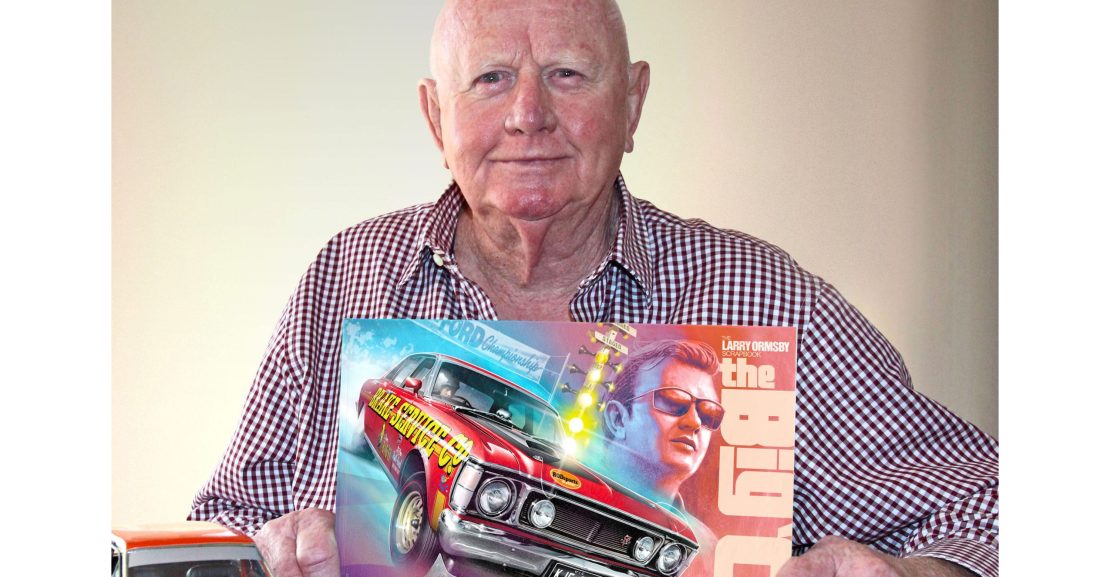
The Australian National Drag Racing Association (ANDRA) is exceptionally saddened by the passing of drag racing legend, ANDRA Hall of Famer, and OAM recipient, Larry ‘Big O’ Ormsby.
Ormsby rose to prominence in the late 1960s with a series of GT and GT HO Falcons in Stock and Pro Stock – with his performances bringing him to the attention of the legendary Al Turner and earning him full Ford Motor Company factory support – before moving on to a series of rear engine dragsters.
In all, he won five Australian Nationals in four different brackets – Stock (1970), Pro Stock (1971), Competition (1976) and Top Fuel (1979 and 1984) – and he was also crowned as the 1984 Australian Top Fuel Champion. He was recognised with the ANDRA Award of Merit in 1980, and inducted into the ANDRA Hall of Fame in 2018.
He was also instrumental in drag racing’s split from the AHRF (Australian Hot Rod Federation) and the founding of ANDRA, becoming its first Chairman of Honour (1974-1978). Over the years he also managed three major racing venues – Calder Park, Adelaide International Raceway and Heathcote Park – and was the General Manager for both RPS Promotions and the ANDRA Winfield Australian Drag Racing Series.
A colossus both on the track and in the boardroom, Larry’s impact on Australian drag racing is undeniable, and he will be sorely missed.
ANDRA extends its deepest condolences to Larry’s family and friends and the entire drag racing community at this very sad time.
In 2023, ANDRA was proud to publish the below special feature on Larry as part of the Association’s 50th anniversary edition of FASTLANE Magazine (text below the images if you prefer to read that way).
Magazine article text:
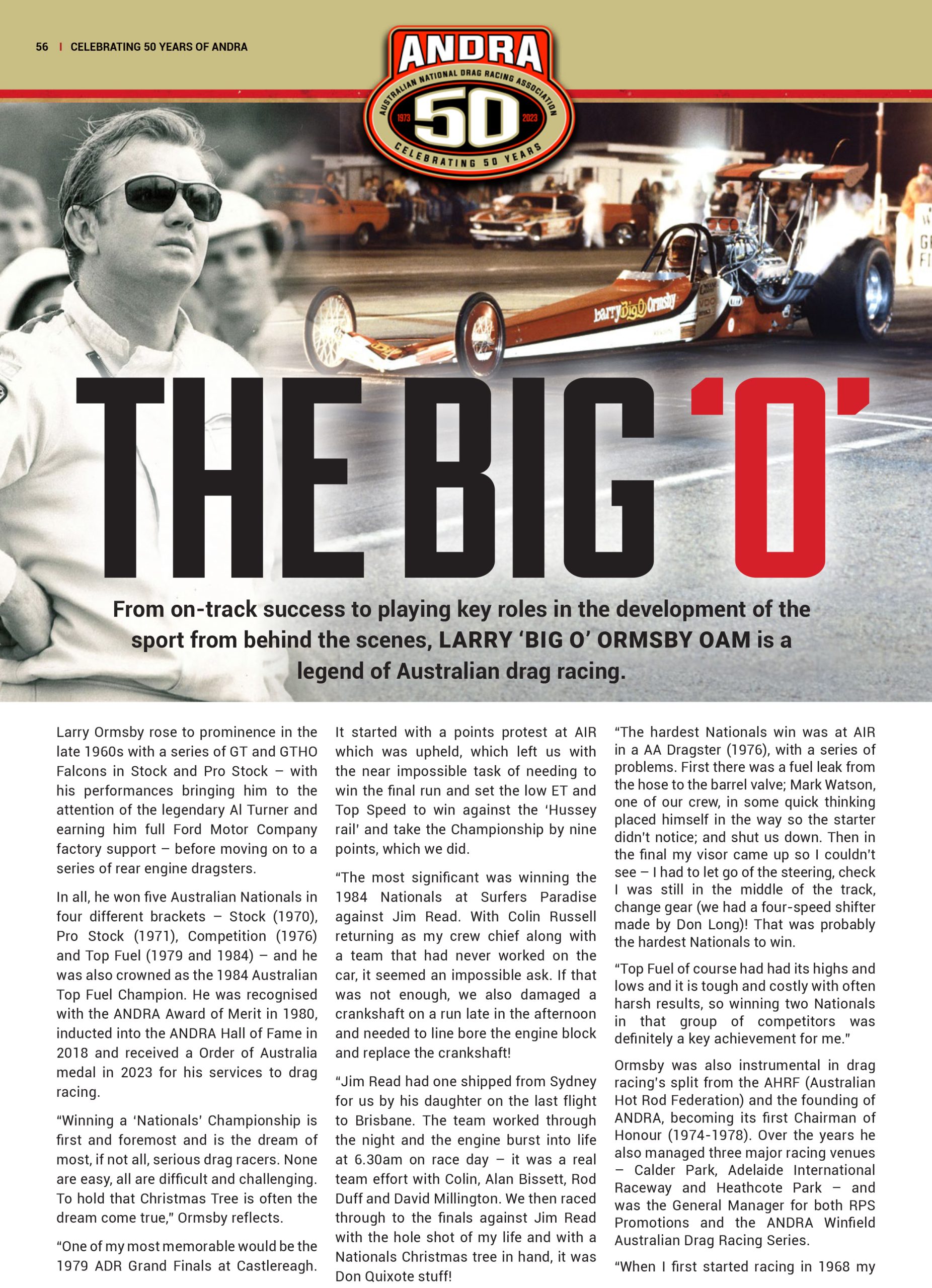
THE BIG ‘O’
From on-track success to playing key roles in the development of the sport from behind the scenes, Larry ‘Big O’ Ormsby is a legend of Australian drag racing.
Ormsby rose to prominence in the late 1960s with a series of GT and GT HO Falcons in Stock and Pro Stock – with his performances bringing him to the attention of the legendary Al Turner and earning him full Ford Motor Company factory support – before moving on to a series of rear engine dragsters.
In all, he won five Australian Nationals in four different brackets – Stock (1970), Pro Stock (1971), Competition (1976) and Top Fuel (1979 and 1984) – and he was also crowned as the 1984 Australian Top Fuel Champion. He was recognised with the ANDRA Award of Merit in 1980, and inducted into the ANDRA Hall of Fame in 2018.
“Winning a ‘Nationals’ Championship is first and foremost and is the dream of most, if not all, serious drag racers. None are easy, all are difficult and challenging. To hold that Christmas Tree is often the dream come true,” Ormsby reflects.
“One of my most memorable would be the 1979 ADR Grand Finals at Castlereagh. It started with a points protest at AIR which was upheld, which left us with the near impossible task of needing to win the final run and set the low ET and Top Speed to win against the ‘Hussey rail’ and take the Championship by nine points, which we did.
“The most significant was winning the 1984 Nationals at Surfers Paradise against Jim Read. With Colin Russell returning as my crew chief along with a team that had never worked on the car, it seemed an impossible ask. If that was not enough, we also damaged a crankshaft on a run late in the afternoon and needed to line bore the engine block and replace the crankshaft!
“Jim Read had one shipped from Sydney for us by his daughter on the last flight to Brisbane. The team worked through the night and the engine burst into life at 6.30am on race day – it was a real team effort with Colin, Alan Bissett, Rod Duff and David Millington. We then raced through to the finals against Jim Read with the hole shot of my life and with a Nationals Christmas tree in hand, it was Don Quixote stuff!
“The hardest Nationals win was at AIR in a AA Dragster (1976), with a series of problems. First there was a fuel leak from the hose to the barrel valve; Mark Watson, one of our crew, in some quick thinking placed himself in the way so the starter didn’t notice; and shut us down. Then in the final my visor came up so I couldn’t see – I had to let go of the steering, check I was still in the middle of the track, change gear (we had a four-speed shifter made by Don Long)! That was probably the hardest Nationals to win.
“Top Fuel of course had had its highs and lows and it is tough and costly with often harsh results, so winning two Nationals in that group of competitors was definitely a key achievement for me.”
Ormsby was also instrumental in drag racing’s split from the AHRF (Australian Hot Rod Federation) and the founding of ANDRA, becoming its first Chairman of Honour (1974-1978). Over the years he also managed three major racing venues – Calder Park, Adelaide International Raceway and Heathcote Park – and was the General Manager for both RPS Promotions and the ANDRA Winfield Australian Drag Racing Series.
“When I first started racing in 1968 my interest was solely on competing and moving from one round to the next. It was only when Jean Pascoe of Calder Park asked me to represent the track at AHRF meetings that my focus started to shift, and that is when I became aware of the variance of interests between the Drag Racer contingent and Street Rodders,” he explains.
“Simply stated, the joint interests of Drag Racing and Street Rodding were no longer compatible. The major difficulties were that while some rodders were racers, most drag racers were not rodders or interested in the Show/Street community. Changes had been discussed at Club level over a protracted period but without a clear indication of how the stakeholders saw a satisfactory outcome.
“Wayne Ruckley as Drag Racing Director contacted me seeking support for a breakaway from the AHRF prior to resigning in late February of 1973. At the time I was heavily committed to my Brake Service business and declined the request. Then Dennis Syrmis became Interim Director prior to John Storm’s (of White House Publishing) election in March of 1973. John also sought my help in establishing a ‘standalone’ administration for Drag Racing, to which I agreed.
“It was also clear that many on the Hot Rod side were keen for the AHRF to remain the ‘Overall Governing Body’ as the highest court of appeal controlling each segments’ interests. This was not what we wanted; our plan was for a completely autonomous entity to govern Drag Racing.
“We ambushed the AHRF AGM meeting on Saturday August 19, 1973. We had decided to pull out all stops to break away completely and in a last minute move, we planned to catch our opposition off balance with drag racing delegates, all attired with shirts and ties, arriving as a group at the meeting start time – flagging that we were serious about the business at hand.
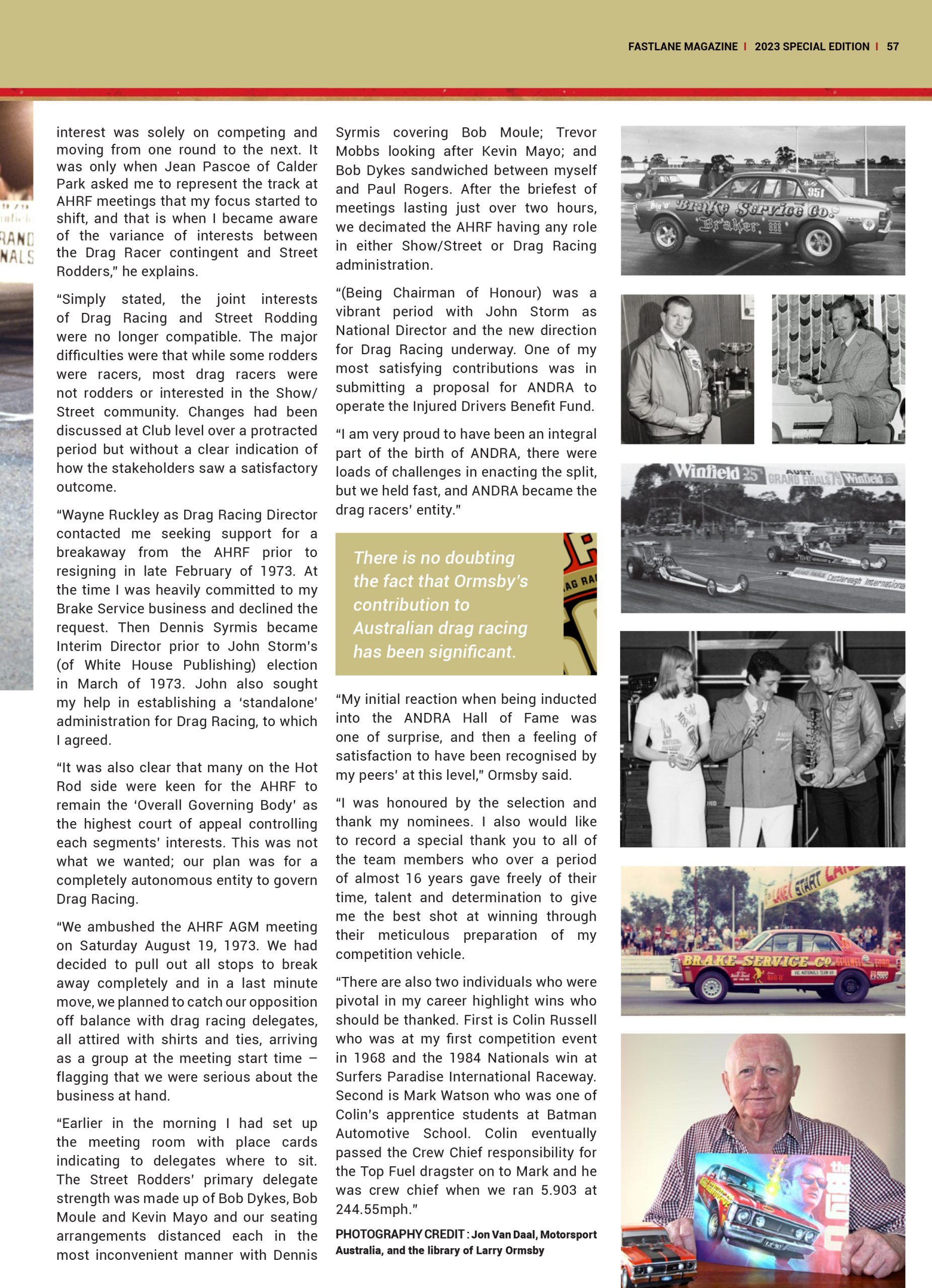
“Earlier in the morning I had set up the meeting room with place cards indicating to delegates where to sit. The Street Rodders’ primary delegate strength was made up of Bob Dykes, Bob Moule and Kevin Mayo and our seating arrangements distanced each in the most inconvenient manner with Dennis Syrmis covering Bob Moule; Trevor Mobbs looking after Kevin Mayo; and Bob Dykes sandwiched between myself and Paul Rogers. After the briefest of meetings lasting just over two hours, we decimated the AHRF having any role in either Show/Street or Drag Racing administration.
“(Being Chairman of Honour) was a vibrant period with John Storm as National Director and the new direction for Drag Racing underway. One of my most satisfying contributions was in submitting a proposal for ANDRA to operate the Injured Drivers Benefit Fund.
“I am very proud to have been an integral part of the birth of ANDRA, there were loads of challenges in enacting the split, but we held fast, and ANDRA became the drag racers’ entity.”
There is no doubting the fact that Ormsby’s contribution to Australian drag racing has been significant.
“My initial reaction when being inducted into the ANDRA Hall of Fame was one of surprise, and then a feeling of satisfaction to have been recognised by my peers’ at this level,” Ormsby said.
“I was honoured by the selection and thank my nominees. I also would like to record a special thank you to all of the team members who over a period of almost 16 years gave freely of their time, talent and determination to give me the best shot at winning through their meticulous preparation of my competition vehicle.
“There are also two individuals who were pivotal in my career highlight wins who should be thanked. First is Colin Russell who was at my first competition event in 1968 and the 1984 Nationals win at Surfers Paradise International Raceway. Second is Mark Watson who was one of Colin’s apprentice students at Batman Automotive School. Colin eventually passed the Crew Chief responsibility for the Top Fuel dragster on to Mark and he was crew chief when we ran 5.903 at 244.55mph.”